Eric Appleton
Creation of a Legacy
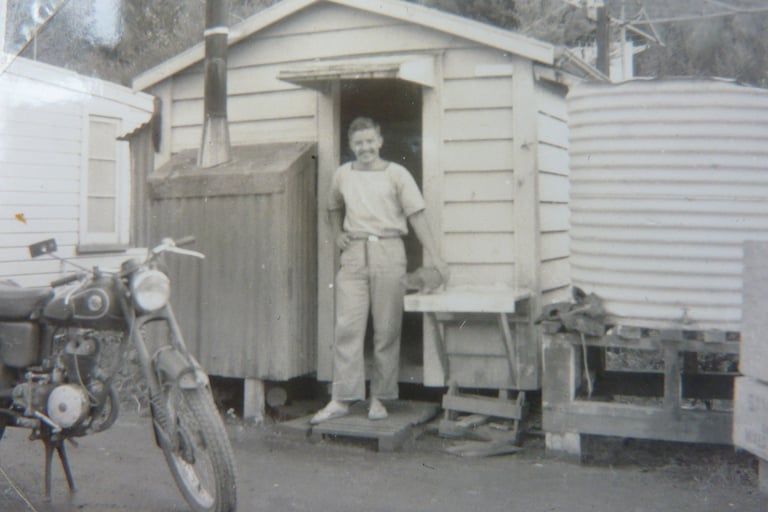
Woodhill forest 1957
In part one, our intrepid traveller and his motorbike made their way across Europe, much of Asia and Australia from Fremantle to Sydney. He was arrested in Yugoslavia, narrowly avoided being assaulted by demonstrators in Pakistan, and pitched off his crippled motorbike on Australia’s Nulabor highway.
After five and a half months, having covered 25,000 kilometres by road and 8,600 kilometres by sea. He arrived in Auckland, on February 18th,1957. His funds were near zero, but there were abundant employment opportunities.
He found two days’ work stevedoring at the port and then did two weeks at a freezing works before securing a job with the forestry service establishing a plantation on the sand country at Woodhill north-west of Auckland. Eric was now on track for a career in the field of his choosing, and for which he was qualified.
He was offered a position as a tutor with the Forest Research Institute in Rotorua, but turned this down, explaining that his stammer ruled him out. A week later, the Institute offered him a job at their research station in Rotorua. There he remained for six months, until a position came up, based at Milton in South Otago, monitoring trial plantings throughout the South Island, south of Hanmer. It was at a dance in Hanmer that he met May, his wife-to-be.
For those seeking security, nothing could beat a government job in post-war New Zealand. Married, with two sons, Robert and Gorden, on a good salary, he was set for life. A secure government position was, however, too secure for Eric, and, in 1962 he applied for a job with Nelson based, timber company, H. Baigent & Sons.
Baigent’s had their own nursery, producing seedlings for their extensive holdings. Less than a week into his job, Eric commented disparagingly to Peter Baigent about the look of the seedling stock. He promptly appointed Eric nursery manager, to put things right.
It's ironic that it was after leaving his career as a researcher, that Eric did his most profound scientific work. At a number of Baigent’s forestry sites there was a problem with tip die-back. This rendered trees worthless, and no one knew what was the cause. Eric set to work to try to find a solution, but everything failed. Then one day, apple expert with the Cawthron Institute, Eric Chittenden, suggested that Eric try boron. Eric set up a trial, and found that boron was the silver bullet. His results have since been repeated by institutes worldwide, wherever there is boron deficient soil.
Eric brought to bear all his energy and enthusiasm in lifting the quality and quantity of seedlings at Baigent’s nursery. By 1967 he had not only doubled Baigent’s production of seedlings for their own forestry blocks, but he was producing a further 2.5 million seedlings to sell to other forestry companies.
That Christmas, Eric received a £10 bonus in his pay packet. May was shocked, appalled, and told Eric that “We should do this ourselves”. Eric agreed, notified Baigent and set the process in train.
While transitioning towards going-it-alone on 1.2 hectares of leased ground, he saw out the summer, autumn and through to the mid-winter dispatch of Baigent’s 1968 crop.
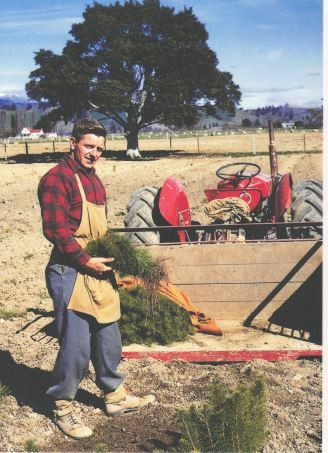
Eric aged 35. 1969. First crop of Pinus radiata seedlings
The Appleton’s move was well timed. Forestry planting boomed in the 60s and 70s.
The Cawthron Institutes research farm, south of Wakefield, came up for sale in 1975. The Appleton’s had, after seven years of toil, banked enough, and were able to borrow enough to buy that eight-hectare property.
Eric and May would have done very nicely focusing solely on pinus radiata, but right from the start they were busy collecting seed of many species to expand the range of seedling trees they could offer.
Doing so, added to the complexity of their operation. Each type, having specific characteristics that had to be accounted for. On the other hand, that complexity suited Eric appetite for innovation.
In the 80s, forestry slumped, and it was Eric and May’s diversification that helped them ride out the trough.
Both Gordon and Robert worked in the nursery, but it was Robert who was to follow in his father’s footsteps. He went to Lincoln to do a one-year diploma in horticulture, then travelled to Canada and Switzerland to further his horticultural experience. Shortly after his return in 1983, his mother died. Sooner than expected, Robert became a full partner in the nursery, and the two men pressed on.
In ?2014? the Appletons purchased forty-five hectares on Mt Heslington Road specifically for producing radiata. The extensive range of other species continue to be grown at the home block south of Wakefield.
Robert brought to the business an aptitude for mechanisation. at a time of when the business was growing vigorously.
Eric married Eileen Maher in 1987, a flamboyant actress who toured New Zealand, and was particularly well known for her one person shows. She was the perfect foil for the more retiring Eric. They were co-adventurers for twenty-five years, but this drew to a close when Eileen was diagnosed with Alzheimer’s. She died in September 2016, aged seventy-two.
Eric is now an incredibly youthful nine-two years old, living just a few steps from the nursery headquarters and is still sharing his encyclopaedic knowledge.
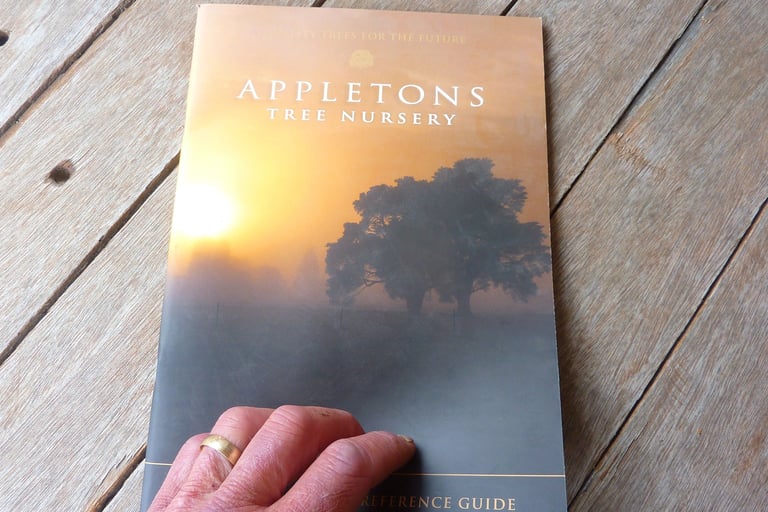
Every year the nursery has produced a revised listing of species and types available. What started a few cyclostyled sheets evolved into a gorgeous publication full of articulate writing, photos, drawings and information about the over five hundred trees and shrubs that the nursery sells.
The catalogue grew into a thing of beauty, but the cost of producing it had become prohibitive. One of my prized possessions is a mint condition copy of the 2019 catalogue. That was the year before Covid, and the final year of the production a catalogue in hard copy form. An annual catalogue is still being produced but needs to be viewed on a computer screen.
Passing on his knowledge has now become Eric’s primary goal. To guide Appleton Tree Nursery into the future, new people have been brought on board, and thus far Eric says that the process has been painless. For the sake of so many individuals and businesses that have come to rely on Appletons, hopefully the nursery will continue from strength to strength.